
The Foot
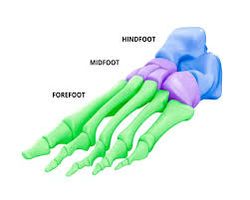
Antomy of Feet
Key Anatomical Regions
Hindfoot (Rearfoot):
Composed of the talus (ankle bone) and calcaneus (heel bone). The calcaneus is the largest bone in the foot, providing a foundation for stability.
Midfoot:
Consists of five tarsal bones: the navicular, cuboid, and three cuneiform bones. This region forms the arch and connects the hindfoot to the forefoot.
Forefoot:
Contains five metatarsals and 14 phalanges (toes). The big toe (hallux) has two phalanges, while others have three. Sesamoid bones are small bones beneath the first metatarsal that aid movement.
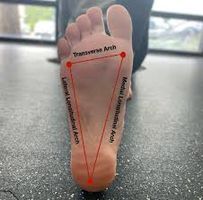
Three Arches of the Foot
The human foot has three main arches—the
medial longitudinal, lateral longitudinal, and transverse arches
Medial Arch -
This is the arch that runs on the inside of your foot.
Lateral Arch -
This is the arch that runs on the outside of your foot.
Transverse Arch -
This is the arch that runs across the bottom of your forefoot at the base of your toe bones.
These structures act as shock absorbers, support body weight, and aid in propulsion during movement. Common variations include high arches (pes cavus) or flat feet (pes planus).
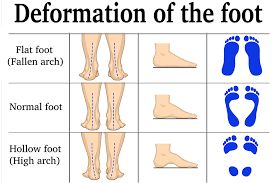
Pronation vs Supination
Pronation and supination describe the inward (pronation) and outward (supination) rolling motion of the foot during walking or running. Pronation flattens the arch, while supination raises the arch. Both are natural, but excessive, prolonged, or insufficient movement can lead to pain or injury.
Pronation (Inward Roll):
When the foot hits the ground, it rolls inward to absorb shock. The arch decreases/flattens.
Over-pronation:
The foot rolls inward too much, often causing flat feet, ankle strain, and shin splints.
Supination (Outward Roll):
As the foot prepares to lift, it rolls toward the lateral (outside) edge, making the foot rigid for push-off. The arch increases.
Over-supination
The foot stays on the outer edge, leading to high arches and potential ankle sprains, calluses, or knee pain.